Showing posts with label book review. Show all posts

Monday, December 21, 2015

Book Review: The Art of Effective Facilitation: Reflections from Social Justice Educators

OK, I’m going to get all academic on you now and recommend a text book.

I can hear you now, “Great, Paul. Just what we want to do at the end of the year.” Give me a moment to explain…wow, tough crowd. :)

I’m pissed these days. No specific reason, just a sense of blah that has carried over for the past couple of months. I know one of the symptoms at least. The news. The never ending detail of stupidity, hate, and all that is wrong in the world.

In past book reviews, I have often shared my opinion yet also tried to hold space for different opinions knowing that “I don’t know, what I don’t know.” Yes, a little Johari’s Window for you Institute graduates. That’s hard to do. Hard to realize that I don’t know everything even with all the degrees I have, seminars I have attended, books I have read, speakers I have heard. Go figure.

So I end up asking this one question…How do we have conversations that matter? How do we start to really talk to one another in dialogue and stop yelling? How do we stop “unfriending” people on Facebook because they think differently than we do? (Like that makes a statement or something.)

Anyway, we are planning the retreat for our Institute Co-Lead Facilitators. This subject of how to hold conversations that matter is part of our focus. In particular, how do you create space for these amazing and talented people to have these conversations? Heck, if these people can’t demonstrate how to dialogue, disagree, learn, and share, who can? I mean really!

So, I turned to my graduate school work and some of the volumes I have collected over the years related to facilitating space for conversations. One of my favorites is The Art of Effective Facilitation: Reflections from Social Justice Educators. So many great chapters on holding conversations that matter and how we as educators (yes, I’m including you LeaderShapers as educators) can create more of those spaces.

Regardless of how passionate you are about social justice issues, you will find some great suggestions on how you can facilitate conversations that need to happen. Maybe even happen when you are around your family over the next couple of weeks. In fact, I bet if we were to start with those that are closest to us (we all have that Uncle…) perhaps we do some of the work that so desperately needs to be done.

I’m working hard to channel my being pissed off into action. I’m going to do so by getting better at creating space for conversations that STILL are not happening (yep, capital letters are probably a sign that I’m pissed).

I invite you to do the same thing. Perhaps then, we can look forward to a new year where we quit yelling AT each other and start to talk TO each other.

Of course, in the mean time, I will keep lighting candles, taking deep breaths, and listening to smooth jazz…

Hope you have a wonderful new year.

Paul

Wednesday, September 30, 2015

Book Review: Tidying Up

I’m having a weird moment as I write this latest book recommendation.

After having done a number of these recommendations over the years, I wonder if you all know a little too much about my issues. Sure, I over share on a daily basis (ask the staff) and tend to be pretty open about my life. However, at what point do you all say, “OK, Paul. Got it.” I don’t think this is the one, but I may be getting close. 

I have a bunch of stuff that I don’t need. From books, clothes, college t-shirts, old concert tickets, and junk drawers (yes, that’s plural), to my office (don’t get me started about organizers), I am realizing yet again how much crap I accumulate. One of the best things about getting engaged and planning to share your life with someone is the inevitable question of “Are you going to keep that?” which is said in such a loving and caring way by your soon to be partner when you know that they are questioning their decision should you respond affirmatively. Oh the fun. Anyway…

So I made the mistake or the good decision of picking up the book by Marie Kondo, “The Life Changing Magic of Tidying Up” and sharing it with my fiancĂ©. I knew it was a good book when she stole it from me and finished it in two days. I knew I would also be impacted by it when she told me to read it immediately. Yep, she told me, didn’t ask. Love her to death. 

Anyway, wow. I was blown away by the mental approach to tidying up being more important than the actual tidying up. If something doesn’t bring you joy when you look at it or touch it, why do you keep it? Damn you, Kondo. Throw my stuff right back in my face why don’t you?!! I’ve looked at clothes I don’t wear any more (bachelor days) and items that irritate me (broken holiday lights), and didn’t bat an eye. Just took it for being a part of my life that was accepted. 

Now, I’m out of control. First of all, “tidying up” is such a better way to say “get rid of your crap” so I don’t avoid it as much. The book’s approach is all about the feel of going through your belongings than it is the actual act of decluttering. Love that. Love the way that I look at my home in a different way. Love the way it makes me think about what is important in life. Love the way that it brings my future partner and I together to be intentional about what we want in our lives. Actually make decisions about what we want in our lives. 

So I did what everyone does when they discover something cool…I posted it to Facebook. By the response from my friends, I’m not the only that has enjoyed the book. I hope you pick it up and feel the same. 

Now back to that pile of clothes in the middle of my bedroom…


Paul

Thursday, August 6, 2015

Book Review: The Road to Character

I find it increasing harder to take the high road because so few people even know that a high road exists. 

Seriously. I struggle thinking about taking the high road, doing the right thing, rising above the fray, when it seems that so few people even care that you are doing so. What’s the lesson in doing the right thing when no one cares about the lesson? Yeah, I can hear you now saying how pessimistic that view is and how can I do that when I work at LeaderShape! We do have our moments from time to time even when we work in such a positive environment. 

I’m not sure if you struggle with the same thing or not, but I’m thinking a lot about it lately. Probably why I have been drawn to books on character, integrity, and beliefs. I’ve been reading the latest book by New York Times columnist David Brooks titled The Road to Character as the title really jumped out at me. Mostly because the title suggests that getting to character takes some travel. Perhaps even a journey. That journey is what intrigues me. Maybe we have to wonder a bit and struggle with these issues continuously as it molds us much like a river molds the river bank and shapes the rocks. 

I’ve mentioned before the importance of staying in hard conversations and “the mess” as a way to address the issues we face as a society and as leaders. That hard conversation can also occur within our own heads as we wrestle with decisions such as whether to take the high road or not. Brooks mentions the difference between “resume” virtues and “eulogy” virtues. Love the way he presents that. The virtues that we adopt to impress other people and the virtues we adopt that will be remembered by. Those are definitely decisions we make in our mind that craft our character and the virtues that we believe in and adopt. 

I think you will enjoy reading this book as you think deeply about those virtues you hold dear, whether you decide to take the high road or not, and how your journey is progressing on the road to character. 

Good luck in that conversation. It may actually lead you to that high road where you may run into someone else trying to do the same. Then maybe it will seem more real. More crowded. More well worn. 

More worth fighting for. 


Paul 

Thursday, July 2, 2015

Book Review: The Good Struggle

One of the things I have embraced over the past couple of years is the concept of the “hard conversation” is not necessarily a bad conversation. It is hard. So what? Lots of things are hard. The unfortunate thing we face in today’s society is that it is easy for many to avoid the hard conversation. We can turn to social media or a myriad of other distractions to see the world the way we want to see the world. Makes it really easy for us to avoid the work we so desperately need to do. Work that helps us to step into these hard conversations.

In any event, I have been reading “The Good Struggle: Responsible Leadership in an Unforgiving World” this past month and actually finished reading it as the SCOTUS decision came down making it possible for everyone to marry the person they love. What an example of the “good struggle” in action. In one chapter, the author asks us whether we have the right core values when we enter these struggles. Quite often it is easy to lose track of our core values and start to defend our need to be “right” instead of our need to learn. 

LeaderShape’s vision of the world is just, caring, and thriving. I think this good struggle has helped us get a little closer to a just, caring, thriving world. Unfortunately, in my opinion, we still have avoided the conversation. The argument may have played out in D.C., but the argument, or rather the conversation, still needs to happen all over the world. Part of winning elections or winning decisions like that is to recognize that we still need each other regardless of how stupid we make think someone else is. The hard work is not finished when you reach 51% of the vote or come to a 5-4 decision. The hard work is in the need to continue to provide space for learning, caring, disagreement, and understanding. 

Of course this past month has had plenty of examples of conversations we don’t really want to have or just haven’t had like the confederate flag flying over government buildings…still. The difficult part of living in a “winner takes all world” is that it creates a constant contest for the next election, vote, or decision. Rather than trying to understand and explain our beliefs, we focus on winning. In this struggle to articulate our beliefs and our viewpoints, we often succumb to the sound bite, the meme, or the headline missing the nuance, the pain, the joy, and the distrust. 

Being a leader is not about doing a victory dance. As leaders, do we ever reach the finish line? Do we ever stop wanting to change the world, make it a better place to live for those that are struggling, or helping someone else do the same? Of course not. Responsible leadership is about being gracious and seeing the big picture. It’s the desire to understand trumping the compulsion to win. 


Some amazing conversations have been happening…let’s stay in the mess and keep the good struggle going. 

Paul

Thursday, April 30, 2015

April: Book Review

My morning ritual is sacred to me. 

Ever since I can remember, I have always been drawn to the morning and I have never really thought about it much. Something about getting up with a routine that makes the morning go smoothly and the rest of the day fall in place. Unfortunately, I am in no way a “morning person.” Not even close. My bed is pretty much my best friend and he tells me that mostly every night. So, what do you do when you wish you were a morning person, like the idea of a thoughtful, paced morning, but struggle to make it work? Well, if you are me, you pick up a new book.

While I was scanning Amazon.com the other day, I came across The Miracle Morning by Hal Elrod. Usually, anything with the word “miracle” in it when it comes to advertising immediately throws up my skeptical face, but I read a few of the excerpts and really liked the approach. In fact, one chapter caught my eye in particular as it relates to LeaderShape and my work. The chapter is titled “Why did you wake up this morning?” What an interesting question, huh? I have seen lots of self-help books and programs that connect questions to your frame of mind, but in all that time, I have never come across that question, “Why did you wake up this morning?” I could have been a smart-ass and said because my alarm went off, but I really thought about it. What is the reason for me being in the world? What is the purpose I am going to pursue? What am I truly looking forward to today? All of these questions came to me as I was reading the very short and useful book. 

Made me think of a number of questions which then made me smile. Maybe the purpose of our mornings can be to ask good questions that get us focused on the work to do that day or the difference I want to make in the world. The ability to focus the start of the day with some space to get clear about our purpose, spend time with your inner most thoughts, and connect to the larger picture of your life. Great stuff to be wrapping our heads around in the morning. There are so many of these books around, but never forget that inspiration and motivation is some times like throwing velcro darts up against a wall…you never know when one of them will actually stick. 

Maybe that is why I do love the idea of mornings. Of course, after a cup of coffee. Let’s be real. 


Paul

Tuesday, March 31, 2015

March Book Review: Community

Wow, what a month.

March was a blur. Not because of the nasty weather – ok, a little bit because of that – but of all the traveling, activities, and events that occurred in my life. From Tampa, to Chicago, to Arizona, to New Orleans, and back to Champaign, there were many nights when I didn’t know where I was when I woke up (no wise cracks).

Anyway, in the middle of it all, we held the Co-Lead Facilitator Retreat for the Institute program. What an amazing, talented, and challenging group we have the privilege to work with. I have never used the phrase “herding cats” before until I started with working with this crew. They give so much to the program and we try hard to provide them with an experience each spring to help them improve their abilities to deliver the curriculum and be present while doing so. 

In preparing for the retreat, I re-read a classic on my shelf, Peter Block’s “Community" because we were focusing on how to infuse the concept of community throughout the six days of the Institute. Simple task on the surface, but not so easy in practice. Block speaks about community in ways that I hadn’t thought about previously and one simple quote hit me and the staff hard - “How are we going to be when we gather together?” Such a simple question and yet amazingly profound. 

How many times have you asked that question before a meeting, before joining a team or organization, before choosing your friends? See what I’m getting at? Being intentional about how we enter community, how we enter the lives of others when we are the outsiders, how we create a space that can be safe and challenging at the same time. How we learn from each other. 

We started some hard and worthy conversations at the retreat, but didn’t get to finish them. Do we ever really finish those conversations that matter? The ones that have a huge impact on the our lives and the world? My thought is no. Once we think we have it all figured out, be careful. Being open to community, being a member of community, is not easy. It is very hard at times. My good friends in fraternity and sorority work are dealing with these questions about community now. Our colleagues who do business in Indiana and other states where threats to our community exist or could exist are dealing with these questions. 

They never escape us. We never solve them. That is the beauty of them. The work. 

I encourage you to pick up Block’s book, read it, think about it, and have a conversation about it with the communities you find yourself connected to. Stay engaged. Stay together. Make time to argue. Make time to be messy. Build a community that includes everyone and lives in possibility. 

Now.

Paul

Saturday, February 28, 2015

February Book Review: "Scarcity"

Wow, do I have a lot of stuff. I’m not talking nice stuff, I’m talking about crap. The problem is I think it is multiplying.

About this time of year (every year), I’m stuck inside the house because the perma-cloud cover we enjoy in Illinois is locked in and I get a chance to look at it while I count the days until spring. I thought that I had thrown out much of my junk over the last few years, but as I was staring at the walls this winter, I barely made a dent.

In particular, I am noticing how much stuff I have bought for my kids. Much of it trying to sooth the pain of their parents going through a divorce, much of it to make me feel less guilty about them having to go through that as well, and much of it because I love to watch them smile. All not necessarily the best reasons to buy things. The problem is that they smile for about 4.2 days and then the stuff becomes stuff. (Cue the George Carlin skit – look it up on Google). I’ve become more committed to having experiences with my children and for myself this year and do without so much. I wish they had weed killer for stuff. Maybe that would help. 

I share this with you because I’ve been thinking a lot about how having too much causes me to enjoy things less because I keep looking for the buzz of a new pair of running shoes, a new sweatshirt, etc. Then, I get clear about the privilege I have to be able to get that stuff and it really hits home about what do I actually need to be happy and what is just a waste. Many people are not in the same position as I am and are far more happier than I am…with less to worry about. Stuff does not equal happy. Having more does not necessarily equal happy. Maybe, having less makes me appreciate what I have even more.

I’ve been reading a book titled “Scarcity: Why Having Too Little Means So Much” which has really brought it all home to me. Brought home the socio-economic privelege that I carry with me and how I’ve learned the hard way that it doesn’t bring you happiness. It gives you a quick fix. My good friend Kristin Skarie speaks about this often and is such a role model for trying to experience more with less. The book brings about a macro view of scarcity and what it means in the world. If you need a change in perspective regarding the perceived “need” vs. “want” then I would highly recommend you pick up the book. 

Even better, pick it up from the library and make sure you bring it back.

-Paul

Friday, January 30, 2015

January Book Review: The Gifts of Imperfection

"I am over trying to be all things to all people. Really, I am."

I figure if I tell myself that over and over again, perhaps I will start to believe it and then eventually actually practice it. I’m getting better at it, but I have a lot of work to do.

One of the interesting personal dilemmas I face every day is my role at LeaderShape. Because I have a title along side my name, I get attributed (both good and bad, but mostly good) to all of the wonderful things that LeaderShape represents. I used to put a lot of pressure on myself to be perfect and represent LeaderShape in a pristine way as if that were even possible.

Then a funny thing happened to me. I got older and I went through a pretty traumatic life experience. That will straighten you up real quick and give you a dose or reality whether you are ready for it or not. I found out soon that I don’t have it figured out, I don’t know all the answers, and that I can’t solve all of the world’s problems on my own. Even more personally, I can’t be all things to my children or myself. That was a sobering thought.

The realization that life is not sterile or conducted in a cocoon can be hard to accept. It is messy. It is hard. It is unexpected. And yet it is wonderful. In fact, the craziness is what makes it wonderful.

I am such a huge fan of Brene Brown. If you remotely find yourself in a similar position, I recommend reading her book, The Gifts ofImperfection. The subtitle is what resonated with me even more…"let go of who you think you’re supposed to be and embrace who you are." Pretty obvious why I was drawn to the book, huh? Brene provides a guide to becoming more resilient, accepting, compassionate, and present. She provides ten guideposts to help us all come to appreciate our imperfections and then develop habits that can help us embrace our authenticity.


We can all use a deep breath, letting the shoulders drop down for a bit, and to smile a smile that says, “I am not alone in this battle to figure everything out.” Maybe the next thought you have is that you don’t really have to.

I used to open up national sessions of the Institute with an inspired, “this will be the best week of your life!” sort of talk. Given the last couple years and my continued walk toward accepting my imperfections, I have changed that talk. I now welcome participants to those sessions with the same beginning and then I follow it with, “…and I hope it is one of the most challenging, frustrating, rewarding, (etc.) weeks of your life. In other words, I hope it is real.” Seems to get a little different reception when I set it up that way. You can feel the pressure in the room dissipate.

Read the book (it is quite short) and embrace who you are. Lead by living your life with all the weird and wonderful stuff that makes you human.

We would probably have a whole lot more patience for those that haven’t reached that point yet and are still trying to be perfect. We can silently tell them, “good luck with that” and continue along our path of imperfection.

Hope you have a great and challenging day.

Paul

Friday, November 28, 2014

November Book Review: Finding the Space to Lead

I went on a personal retreat of sorts back around Labor Day and the effects have worn off. Ugh.

It was one of the most inspiring, pensive, and soul searching experiences I have had, which is sad because it was only going away for a few days with the intention of being quiet and thinking. Sad because I had to go away to do that and sad that it took mountains, blue skies, and solitude to make it happen. Sad because it's the first time I have ever gone away on my own. Sad because I so wanted to stay and be a hermit (if only I could have my kids too…they really are cute and fun).

Anyway, the effects have worn off. Yep, gone. I was writing in a journal all day, taking deep breaths, not checking my phone, eating well, sleeping long, working out like those crazy cross fit folks. Not so much now. Get me a cheeseburger and hold the veggies. I have a sneaky suspicion that I am not alone. 

One of our biggest challenges is to find the space to be mindful and pay attention to what is actually going on in front of us without having to spend all the money to find some remote mountain top to do so. I've been following Janice Marturano on Twitter for some time now and really resonate with her thoughts on this subject especially as it resonates around leadership. How do leaders find the space to be mindful? When so much needs to be done, when time is going by faster and faster (how is it Thanksgiving already!), when technology seems to be adding to it instead of helping it, what are we to do?

I recommend you read Janice's book, Finding the Space to Lead, and I recommend you do one thing to help if you remotely feel the same. Take a walk over the holidays. Take a couple of them. Put on the big coat that isn't fashionable and get outside. Janice spends a whole chapter talking about doing just this. I'm not talking about a power walk, I'm talking about a "I've got no place to be any time soon" sort of walk. The holidays can be hectic and the urge to phone it in until January 2nd is strong.  

I also recommend you build an Adirondack chair. OK, maybe buy it. Then place it outside and sit in it. Leave the phone inside. Sit until your butt goes numb and let the mind unwind. A glass of wine has helped me, but it could be cup of tea as well. I've got to get back to that "mountain top" some way. I guess recognizing the problem is the first step, huh? 

In fact, I'm sure it is. Wishing you a mindful holiday season. You will be a better leader for it. You will be a better person for it. 

Now where is that journal of mine…

Paul

Friday, October 31, 2014

October Book Review: Essentialism

I have too much stuff. 

Too much physical stuff that I will never use or that I can't get myself to throw away because I just know I will need it some day. Yeah, right. Probably the "stuff" that I notice the most these days is the mental stuff. The things I am not doing, need to do, want to do, and my daughter's favorite songs from the Disney Channel that I can't get out of my head. 

Like many people these days, I am noticing more and more the movement towards having less or really needing what you have. A good friend of mine, Jeffrey Cufaude, recommended a book to me recently that he wished he would have written (he could have) and that I completely resonated with…Essentialism by Greg McKeown. The cover tells you all you need to know about the inside of the book. Look at it and you will understand. The subtitle is "the discipline pursuit of less" and we can all agree that discipline is in fact what is needed to get to what really matters in our lives.

McKeown focuses on four main concepts: Essence, Explore, Eliminate, and Execute with additional concepts to flush out his points within each. I have always resonated with the power of choice and speak often about that in my role at LeaderShape and to others as the most important power we have…to choose the meaning we give to events in our lives and to know that we ALWAYS have that power. The meaning people give to our lives, the meaning stuff gives to our lives, and the meaning of the interpretations of what occurs in our lives.  I will highlight one other concept which caught my eye as LeaderShaper…uncommit. We speak at LeaderShape about making commitments and being a person of integrity, but not much about uncommitting from the things in our lives that create chaos and lack of clarity. Uncommiting is probably just as important to committing when you think about it, right? What are those things that we really should not be engaged with that sap us of energy and time? 

I may not stop watching the Blacklist on Monday nights, but at least I am thinking of what decisions I am making in my life. What is essential and what distracts me from my vision and who I want to be. One of our Co-Lead Facilitators, Kristin Skarie, went a year without buying ANYTHING new. Bet she found out what is essential in her life, huh? 

What is essential to you? What is practicing essentialism? Pick up the book and see how it might influence the choices you make every day. I think it will make you a better leader, a better decision maker, and a better person. 


Enjoy.
Paul 

Tuesday, September 30, 2014

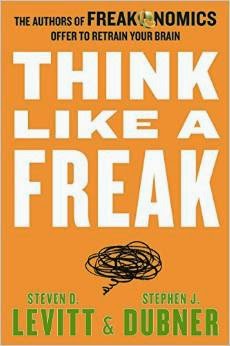
September Book Review: Think Like A Freak

I'll be honest that I haven't been reading as much as I usually do. Most of that is an issue of the summer and being busy coaching baseball, doing yard work, taking and picking up kids from camp, and work. Mostly work. However, I've gotten back into it with a vengeance and began tackling the pile of books that has accumulated over that time. I do love my Kindle, but there is something to holding the book, dog-earing pages, and using a highlighter. Thus, the stack. I really did intend to read them when I bought them. Honest. Be warned though, I read more on the edges of leadership these days given that most of what is written about leadership these days seems to be repackaged. I must be getting old.

Anyway, I've been thinking a lot these days about asking good questions because I believe that most of the major issues we face in the world are a result of asking bad questions. Asking questions of "who is to blame" instead of "what are WE going to do about it," is just one example. So I'm gravitating to books that help me think more clearly, more often, and more openly. I found a really good one that you should pick up by Steven Levitt & Stephen Dubner…two economists…hang with me.

They are the authors of Freakonomics, Superfreakonomics, and their latest Think Like a Freak. All of them made me go "hmmm" out loud because they look at issues, problems, and challenges from the perspective of asking good questions to get at the root cause not just what it would appear to be on the surface. Our news comes to us pre-washed and shrunk to sizes that apparently we consume best – two sentence tweets. With that, we miss nuance, debate, perspective, the works. I truly believe that if we moved past the lens that we have crafted to see the world and actually see the world for what it is, many of these challenges facing us could actually be addressed. 

Kicking the can down the road is not a solution any more. We will continue to find ourselves asking why we are in the same place as we were years before. Being economists, the authors write a lot about incentives and how to truly influence other people. As LeaderShapers, we embrace living in possibility every day and thinking about how best to influence others and ask good questions seems like an exercise worth doing.  I would pick up Think Like a Freak as it is their latest and I think best book. I think you will really enjoy reading it. It's hard to put down.


On to the next book in the stack.  Here we go…

Paul